
New publication
30 October 2026 | Populations
A new article by Prof. Samir KC, published on 30 October 2026 in Populations, extends the Wittgenstein Centre population projections for the Shared Socioeconomic Pathways (SSPs) from 2100 to 2300. It covers 200 countries and keeps the full detail by age, sex and six levels of education.
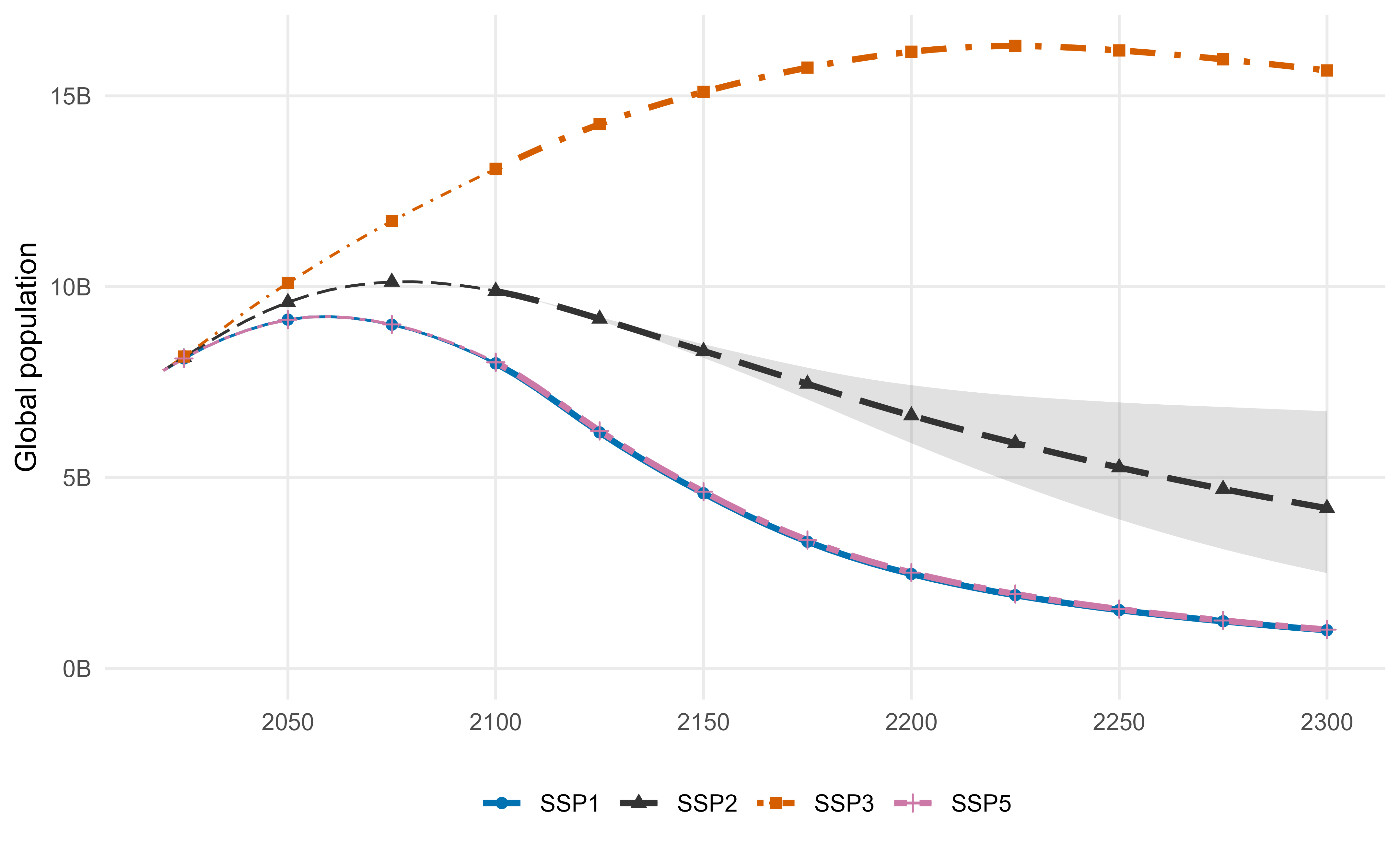
Most population projections stop in 2100, close to the moment the world population peaks. The extended pathways show what comes after. On the middle-of-the-road pathway (SSP2), world population peaks around 2080 at about 10.1 billion and falls to about 4.2 billion by 2300, with more than one person in five aged 80 or over. With low fertility (SSP1) it approaches 1 billion; with high fertility (SSP3) it passes 15 billion.
Nepal follows the same arc, earlier. On SSP2 its population peaks around 2060 at about 35 million and falls to about 12 million by 2300, when half of all Nepalis would be older than 55.
The projections are open data, so researchers in Nepal and elsewhere can use them for long-run planning and climate studies.
Article and data
KC, S. (2026). Humanity After the Peak: Extending Shared Socioeconomic Pathway Population and Human-Capital Projections to 2300. Populations, 2(4), 23. DOI: 10.3390/populations2040023. Open access.


Leave a Reply