
Research platform
POPSYM: Population Systems Model
A modelling and research direction for connecting population change with education, labour, health, housing, infrastructure, resources, and policy questions.
The idea
Start with people, then connect the systems around them
Population change is not only about how many people there will be. It is also about where people live, how old they are, what education they have, how they participate in work, how they move, and what services and resources they may need.
POPSYM is PSR HUB’s long-term effort to connect demographic projection models with wider social, economic, and environmental questions. The aim is to make population evidence more useful for planning, policy, teaching, and public communication.
Core question
How can demographic models help societies prepare for future needs in education, health, labour, housing, care, infrastructure, food, water, energy, and local development?
What POPSYM connects
From demographic projections to planning questions
Population structure
Age, sex, location, education, labour force, migration, household, and other demographic dimensions.
Human capital
Education, skills, training, work, productivity, and the changing composition of future populations. The approach is now also being applied in Turkmenistan, building a national skills demand model with UNDP and the Ministry of Education.
Needs and services
Health, schooling, care, housing, transport, food, water, energy, waste, and other planning needs.
Scenarios and uncertainty
Alternative futures based on fertility, mortality, migration, education, labour, and policy assumptions.
Outputs
How POPSYM will appear on PSR HUB
Research
Papers and project hubs
Academic papers, working papers, project notes, and research hubs connected to population systems modelling.
Tools
Dashboards and models
Interactive dashboards, Shiny apps, visualization tools, and reproducible workflows linked to modelling outputs.
Communication
Cards, briefs, and teaching
Visual explainers, policy briefs, training materials, and public-facing summaries for wider audiences.
Publication
The POPSYM paper
6 August 2026
Journal article
Population-Based Systems Models for National Planning: A Proposal for Country-Owned Demographic Systems Infrastructure
Samir KC sets out POPSYM as a country-owned analytical infrastructure that places population dynamics — fertility, mortality, migration, urbanization, ageing, education, and labour force change — at the centre of integrated national planning. It connects demographic projections to health system demand, school planning, housing pressure, food and water security, climate risk, consumption, and spatial inequality, evidence that is otherwise fragmented across ministries, statistical offices, surveys, and dashboards.
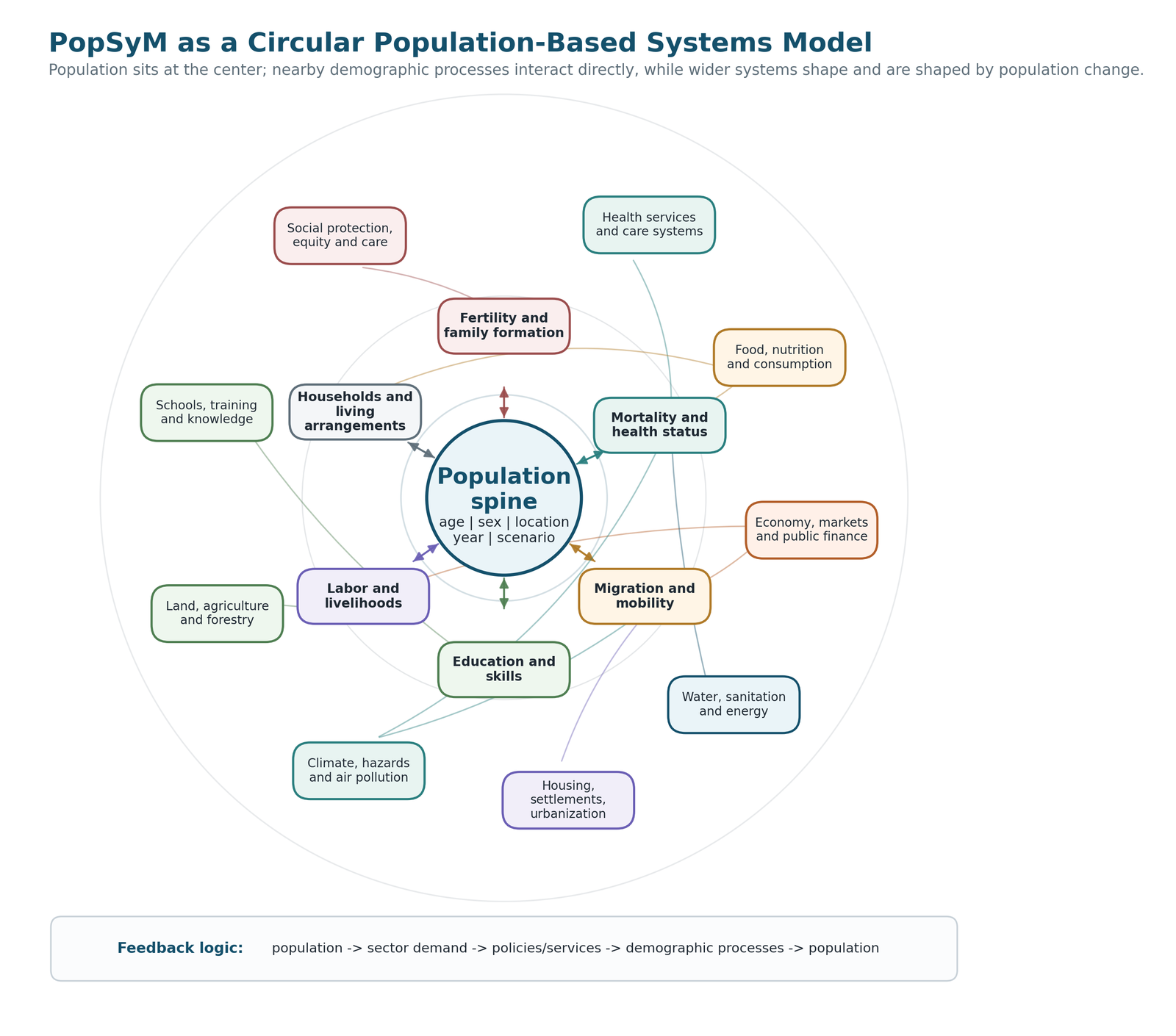
The paper carries all three of Samir KC’s affiliations, reflecting work done jointly across the International Institute for Applied Systems Analysis (IIASA) in Laxenburg, the Asian Demographic Research Institute (ADRI) at Shanghai University, and the Population and Statistics Research Hub (PSR HUB) in Kathmandu.
Populations, 2(3), 16. DOI: 10.3390/populations2030016.
Read paper · IIASA feature: Planning for the future through a population lens
Research questions
Questions that guide the platform
- How will changes in population size and structure affect future demand for education, health, labour, housing, and care?
- How can subnational projection models support local planning and resource allocation?
- How do fertility, mortality, migration, education, and labour force assumptions shape future scenarios?
- How can dashboards, visual cards, and public communication make demographic evidence easier to use?
- How can population systems thinking help governments, researchers, and institutions prepare for uncertainty?
Collaborate on POPSYM
For research collaboration, modelling, dashboard development, teaching, or policy applications connected to POPSYM, contact the PSR HUB team.

